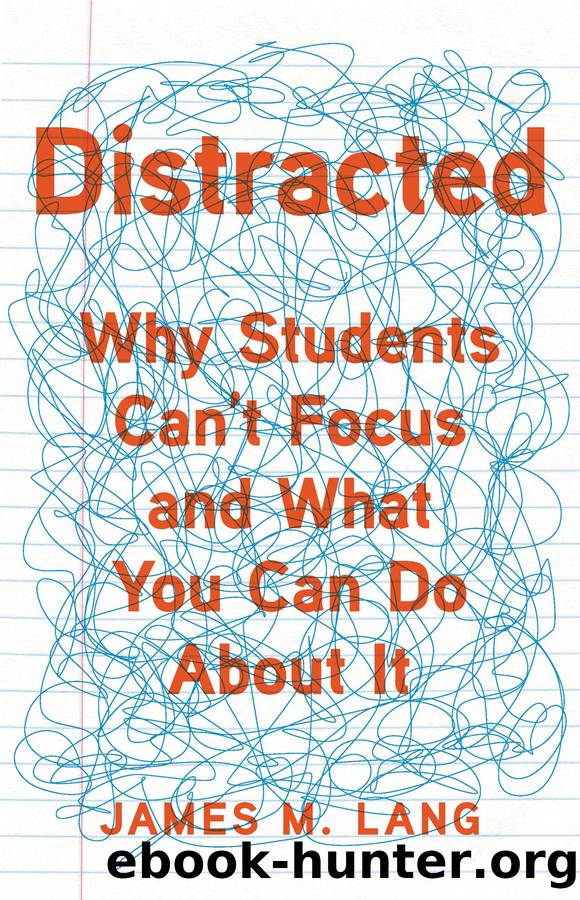
Distracted : Why Students Can't Focus and What You Can Do About It (9781541647565) by Lang James M
Author:Lang, James M. [Lang, James M.]
Language: eng
Format: epub
Publisher: Hachette Book Group USA
Published: 2020-10-20T00:00:00+00:00
The Daily Questions
Questions designed to evoke the situational curiosity of students should continue beyond the first days of the semester. The first time I observed a question-based lesson plan was a decade ago, when I visited the classroom of Greg Weiner, then a professor of political science and now the provost of Assumption University. At the beginning of class, he showed students four questions on a slide. He then proceeded through a standard mix of lecture and discussion. At the end of the period, he returned to the questions in order to remind students that the class material for that day had been intended to supply them with potential answers. This strategy had the positive side effect of demonstrating to students that they had acquired some concrete knowledge over the course of the class period: their ability to answer the questions on the slide at the end of class meant that they knew more than they had before. Weiner had also made those questions available to the students in advance of class, to help guide their reading and homework. But having the questions visible at the start was designed to draw out their curiosity in those crucial opening moments of the period.13
Another colleague of mine, Aisling Dugan, takes a different approach: the question is the same every day, but it is applied to different content. Dugan teaches a course in microbiology on my campus, and she begins each class period by putting up a slide with the âmicrobe of the day.â Next to the name and image of the microbe, she lists some categories that scientists would use to understand and classify it. The question she poses is a simple one: âWhat can you discover about this microbe in each of these categories?â Class formally opens with students spending five minutes looking up everything they can find about that microbe, using their phones and laptops. Dugan allowed me to observe this opening ritual in her class one afternoon, and it was striking to see how quickly the pre-class student conversations quieted down, and how intently the students became absorbed in this five-minute task. My informal survey of the room, from my vantage point in the back row, showed me that every student was on task during those five minutes, seeing what they could discover about the microbe of the dayâwhich was the one that causes the plague, chosen playfully by Dugan to mark Halloween that day. After five minutes were up, she asked students to report what they had learned. Together the room filled out the picture of this scary microbe, and throughout Dugan was able to connect their findings to other questions: âDo you remember which previous microbe had that shape? And where do anaerobic microbes live in the body?â Duganâs classroom demonstrates that we donât have to scramble to find completely different questions every day. The basic form of the question might remain the same, but we can apply it anew to each dayâs course material.
My favorite method
Download
This site does not store any files on its server. We only index and link to content provided by other sites. Please contact the content providers to delete copyright contents if any and email us, we'll remove relevant links or contents immediately.
The Art of Coaching Workbook by Elena Aguilar(51381)
Trainspotting by Irvine Welsh(21967)
The Secret History by Donna Tartt(19466)
Twilight of the Idols With the Antichrist and Ecce Homo by Friedrich Nietzsche(18775)
All the Missing Girls by Megan Miranda(16686)
Cat's cradle by Kurt Vonnegut(15551)
Ready Player One by Cline Ernest(15139)
Talking to Strangers by Malcolm Gladwell(13535)
Fangirl by Rainbow Rowell(9461)
The remains of the day by Kazuo Ishiguro(9216)
The Compound Effect by Darren Hardy(9146)
Thirteen Reasons Why by Jay Asher(9110)
Tools of Titans by Timothy Ferriss(8591)
Periodization Training for Sports by Tudor Bompa(8415)
Wonder by R. J. Palacio(8239)
A Court of Wings and Ruin by Sarah J. Maas(8107)
The Lover by Duras Marguerite(8042)
Change Your Questions, Change Your Life by Marilee Adams(7929)
Giovanni's Room by James Baldwin(7540)
